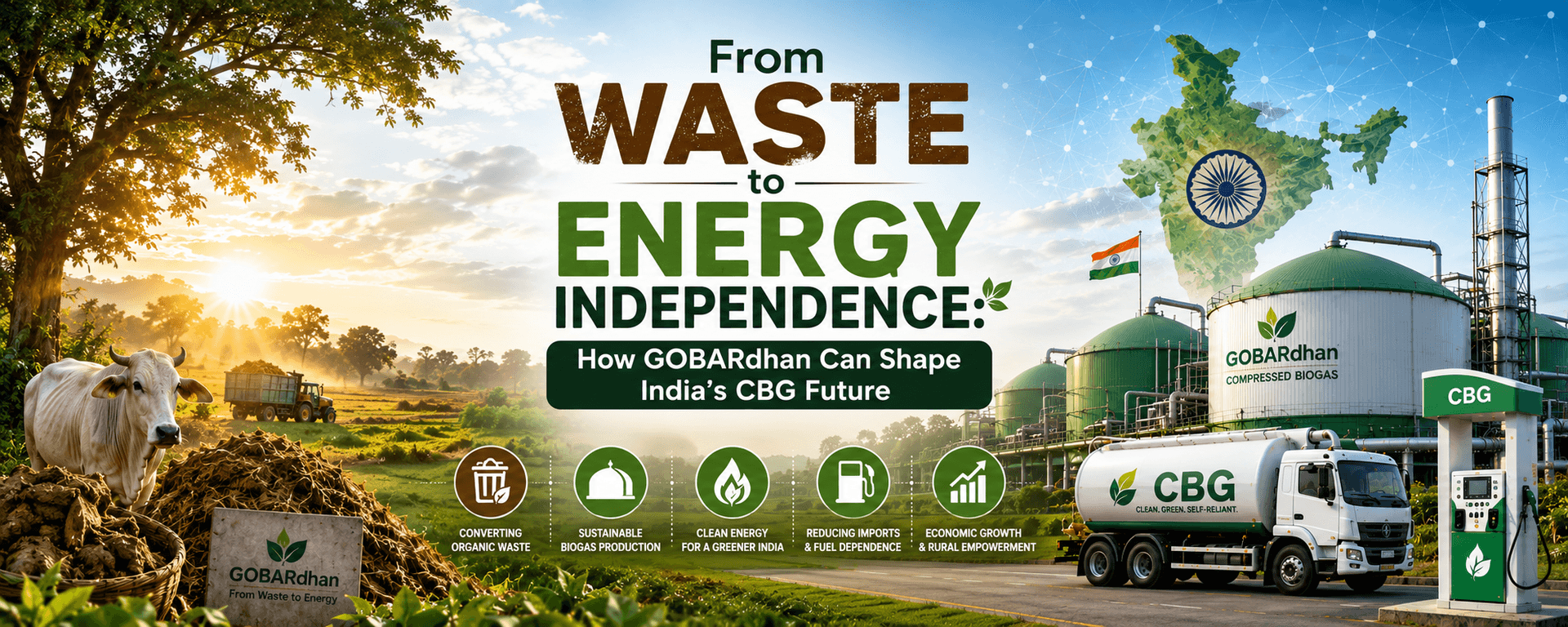
From Waste to Energy Independence: How GOBARdhan Can Shape India's CBG Future
India's Independence Day is a moment to remember the journey that brought the nation its freedom and to think about the responsibilities that come with it. Over the decades, India has made remarkable progress across agriculture, manufacturing, infrastructure, technology and energy. Yet energy security remains one of the strategic challenges of a growing economy. India currently meets nearly half of its natural gas requirement through imports. At the same time, the country generates enormous quantities of agricultural residue, cattle dung and other organic waste. What if a part of that waste could become a domestic source of clean energy? That is where Compressed Biogas (CBG) becomes particularly important. And with the Union Cabinet's approval of the new GOBARdhan: National Unified Scheme for Compressed Biogas, India has entered a new phase in the development of its CBG ecosystem.
From GOBARdhan to a National CBG Framework
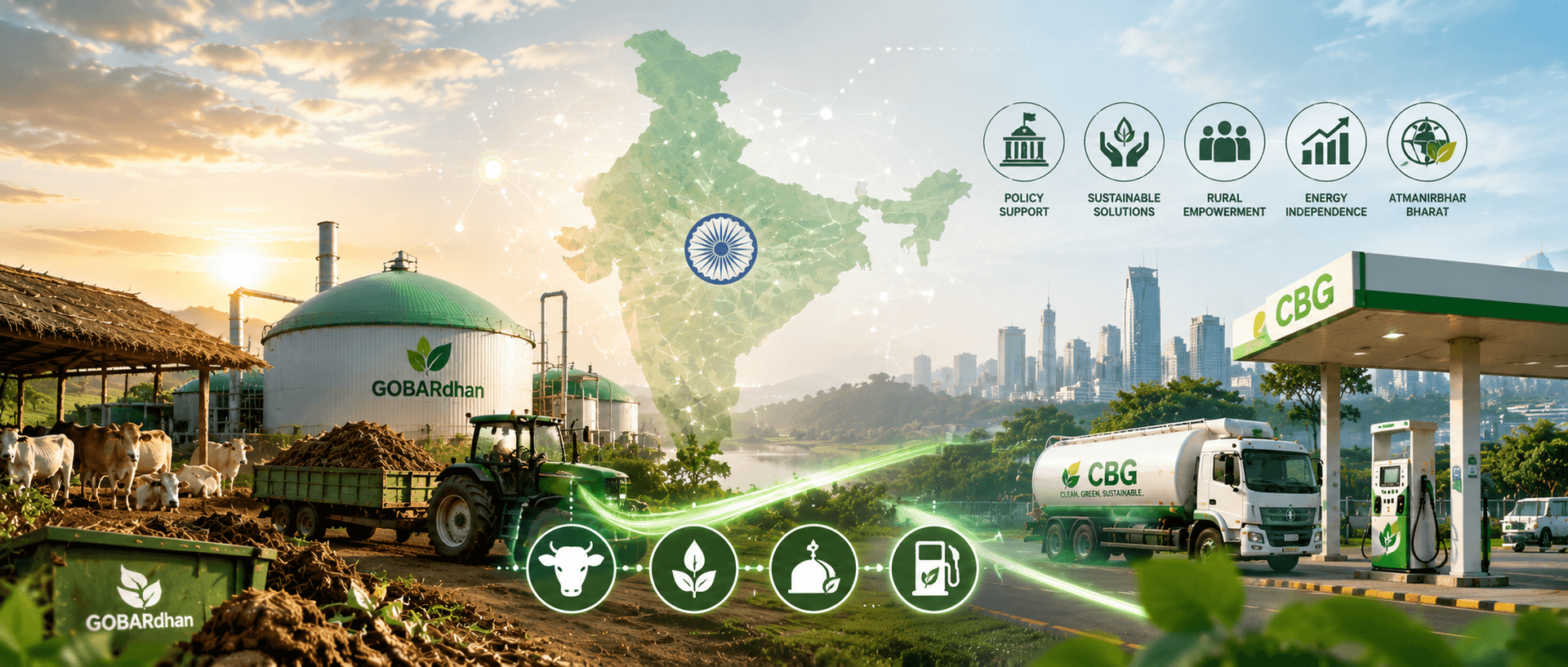
The GOBARdhan initiative was originally launched in 2018 under the Swachh Bharat Mission (Grameen) to promote the conversion of cattle dung and other organic waste into useful products such as biogas and bio-slurry.
Over the years, multiple government interventions have contributed to the development of India's CBG ecosystem, including SATAT, Market Development Assistance for organic manure, biomass aggregation support, pipeline infrastructure initiatives and Central Financial Assistance under the National Bioenergy Programme.
On 6 August 2026, the Union Cabinet approved GOBARdhan as India's National Unified Scheme for Compressed Biogas, with a total outlay of ₹23,731 crore. The scheme will be implemented from FY 2026–27 to FY 2035–36, with the Ministry of Petroleum & Natural Gas as the nodal ministry.
Its stated ambition is significant: to increase domestic CBG production by nearly ten times, mobilise large-scale private investment and create a stronger circular bioeconomy across India.
Why CBG Matters to India's Energy Future
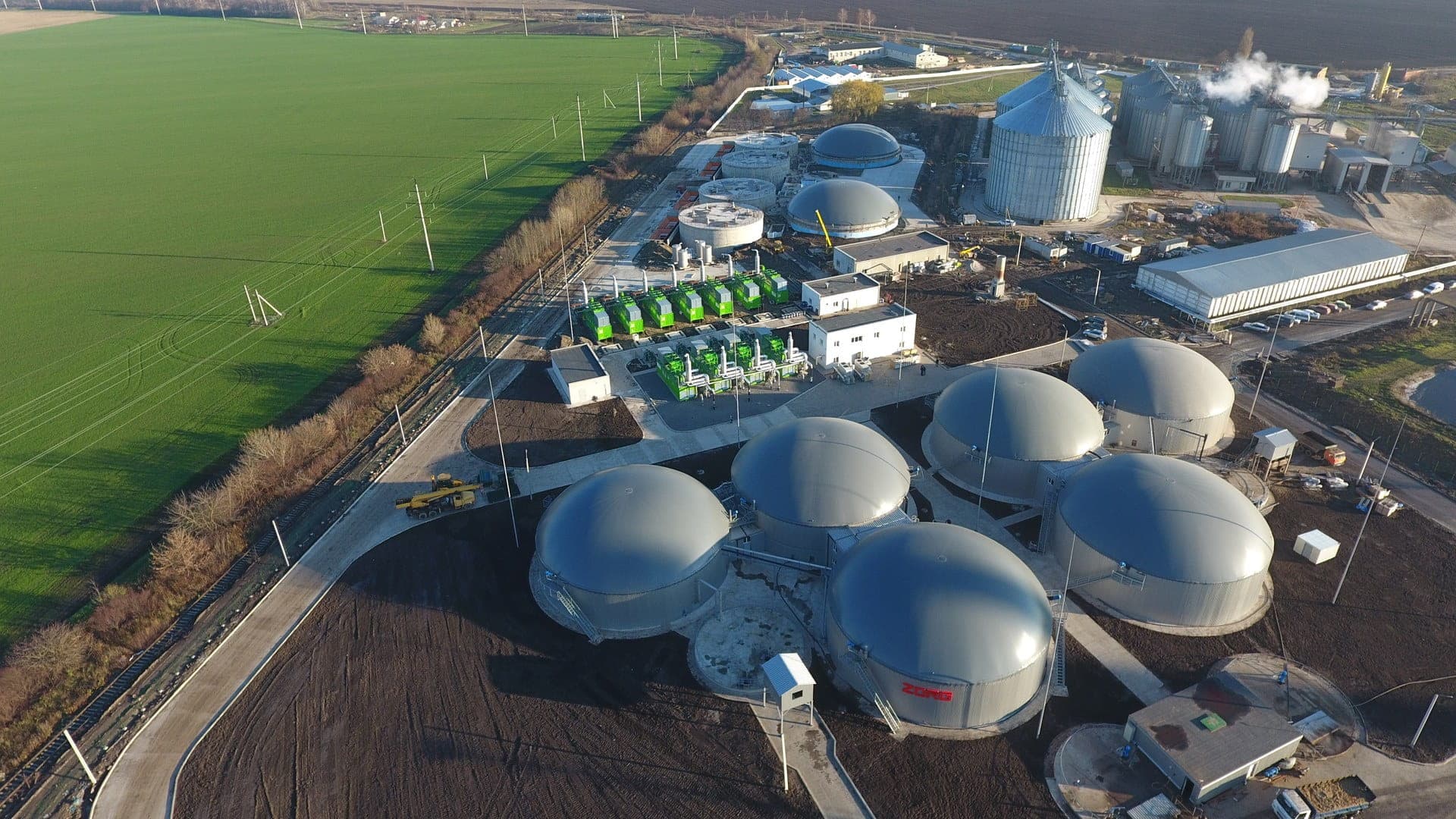
CBG is produced by processing organic feedstocks such as agricultural residue, cattle dung and other biodegradable resources through anaerobic digestion. The resulting biogas is then purified and upgraded to a quality suitable for use as compressed renewable gas.
A well-designed CBG project connects several economic activities within one circular system: Agriculture → Biomass → Biogas → CBG → Clean Energy → Organic Manure → Agriculture.
For farmers and rural communities, this creates opportunities across biomass collection, aggregation, transportation, plant operations and organic manure value chains. For India, it contributes to a more diversified domestic energy mix. For businesses and investors, it creates a new infrastructure opportunity at the intersection of energy, agriculture, waste management and technology.
What the New GOBARdhan Framework Brings to the Table
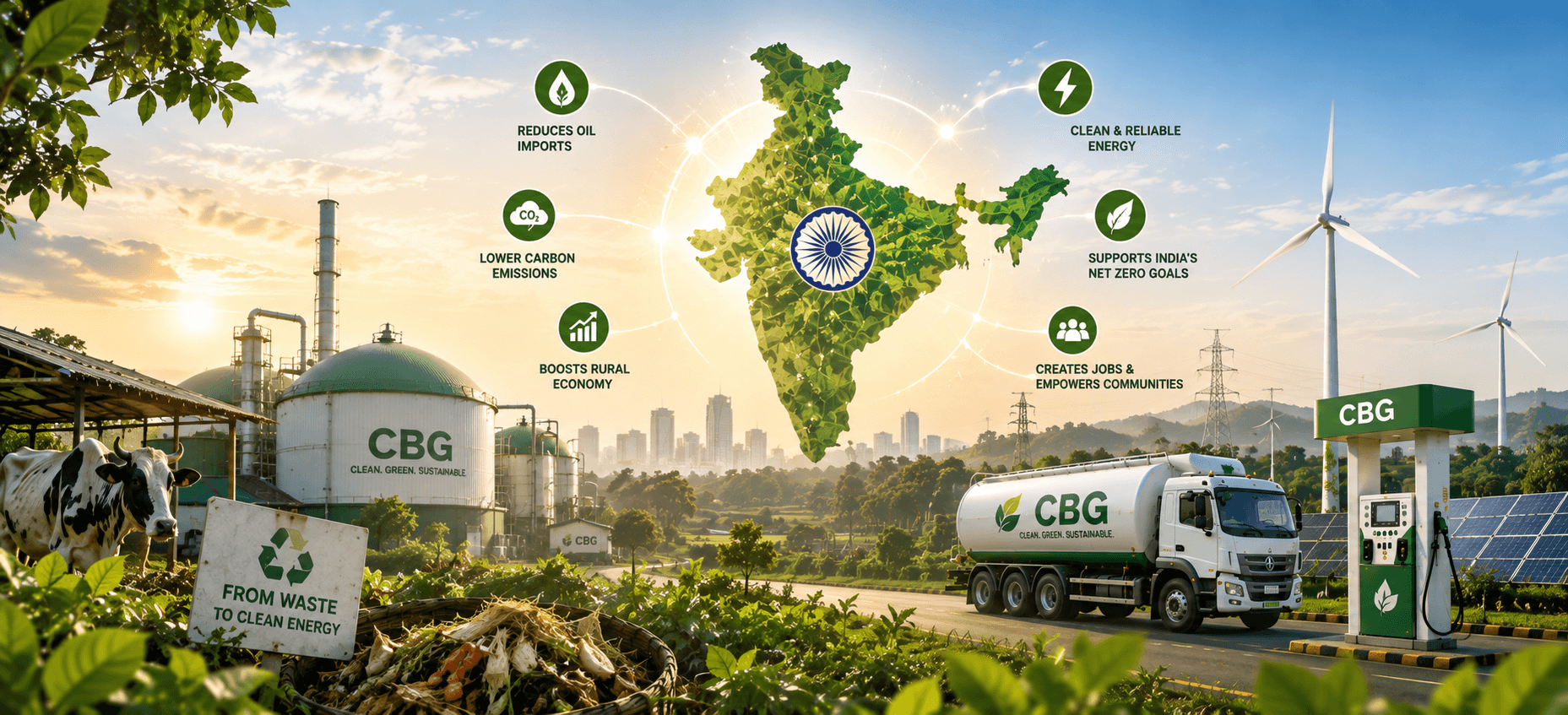
1. A stronger demand framework: an assured CBG offtake linked to a notified obligation trajectory — 3% in FY 2026–27, 4% in FY 2027–28, 5% from FY 2028–29 onwards for CNG (Transport) and PNG (Domestic) segments.
2. Stable pricing framework: a government-backed administered CBG price of ₹2,110 per MMBTU (approx. ₹105 per kg), with a minimum ten-year revenue horizon.
3. Capacity-linked capital assistance: up to ₹2 crore per tonne per day (TPD) of installed CBG capacity for eligible greenfield projects, linked to capacity (not a blanket CAPEX subsidy), extending to feedstock aggregation and organic manure assets, with brownfield expansions also eligible.
4. Pipeline infrastructure: support for connecting CBG plants with trunk pipelines and City Gas Distribution networks to reduce evacuation costs and expand market reach.
5. Credit guarantee support: a dedicated mechanism offering credit guarantee coverage of up to 85% on eligible loans for MSME-based CBG projects.
6. A CBG Ecosystem Challenge Fund: focused on feedstock resource assessment and mapping, feedstock aggregation infrastructure, district-level CBG planning, technology adoption, organic manure value addition, and capacity building.
The Real Opportunity: Building Projects, Not Just Policies
Policy can create the conditions for an industry to grow, but infrastructure ultimately has to be designed, financed, engineered, constructed, commissioned and operated.
A CBG project is a complete project-development exercise: Feedstock assessment → Site selection → Feasibility → DPR → Technology selection → Financial planning → Approvals → Engineering → Procurement → Construction → Commissioning → Operations.
Feedstock quality determines the foundation of the project. Technology selection affects process efficiency. Engineering determines how systems work together. Project management determines how effectively timelines, costs and execution are controlled. And the commercial model determines long-term sustainability.
Where KEC Agritech Fits Into India's CBG Opportunity
KEC works across project assessment, development, management and commercialization, with capabilities spanning Project Management Consultancy (PMC), Engineering Procurement & Construction (EPC), project development, turnkey solutions and Operation & Maintenance support.
This includes: Feasibility Assessment & DPR, Engineering & EPC, Project Management Consultancy, CBG Plant Development, CBG Park Development, and Process & Technology Solutions.
The objective is simple: build projects that are technically sound, commercially structured and designed for long-term operation.
India's Waste Can Become India's Energy Resource
The larger significance of GOBARdhan is that it connects two of India's greatest strengths — its agricultural economy and its growing energy demand: Waste → Resource → Energy → Value → Agriculture.
According to the Government's 2026 GOBARdhan backgrounder, the scheme is expected over its ten-year horizon to support nearly ten-fold growth in domestic CBG production, generate more than ₹75,000 crore in national GDP contribution, create over 1.5 lakh jobs across the value chain and produce 250 MMT of organic fertilizer.
The Next Chapter of Energy Independence
India's freedom journey has always been about building the capacity to determine its own future. Today, energy independence is an important part of that journey.
The new GOBARdhan framework creates a stronger policy foundation. The opportunity now lies with entrepreneurs, investors, farmers, technology providers, financial institutions and project developers to build on it.
At KEC Agritech, CBG is seen not merely as a fuel opportunity, but as an opportunity to build a larger ecosystem connecting energy, agriculture, waste management and rural economic development. Because policy creates the opportunity. Engineering turns it into infrastructure. And infrastructure turns a national vision into something that works on the ground.
The KEC Engineering Standard™ — Build It Right.™ Build It With KEC.™ Happy Independence Day! Jai Hind!
Share Article
About Author
KEC Bio-Fuel Team
Expert in renewable energy and sustainable agriculture
Article Stats
Related Articles
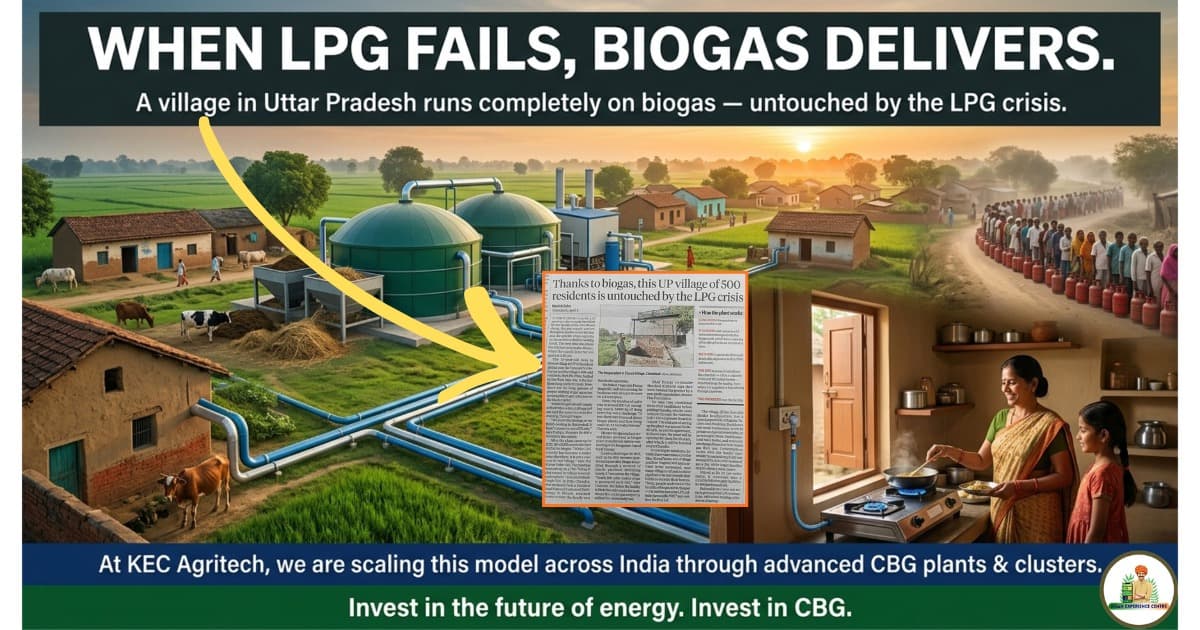
From LPG Crisis to Energy Independence — Why CBG is India’s Most Practical Solution
Recurring LPG shortages, rising prices, and import dependency are pushing India toward decentralized energy solutions. Compressed Biogas (CBG) is emerging as the most practical and scalable path to energy independence.
In CBG, 'Sasta' Is Not Smart — 'Sabse Achha' Is Sustainable
Why quality matters more than initial cost in CBG plant investments. Discover why smart investors focus on 15-year performance over short-term savings, and why locking your project before December 31st, 2025 is a strategic advantage.

This Dhanteras: Invest in the Future – Not Just in Gold!
How CBG and KEC Agritech are powering India's energy revolution while turning agricultural waste into wealth. Discover how this Dhanteras, investing in Compressed Biogas (CBG) — India's new 'Green Gold' — can create sustainable income, empower farmers, and fuel the nation's clean energy future.